Speaker Nancy Pelosi on Public Transit

Posted: June 3rd, 2008 | Author: Rob Goodspeed | Filed under: Green-TEA, Light Rail, Transit, Transportation | 2 Comments »

From a speech to the annual meeting of the American Public Transportation Association:

Last year, public transportation ridership reached its highest level in 50 years. While this upward trend is tremendously encouraging, it is overloading many of your systems, and making the need for infrastructure investment all the more pressing.

The question is not whether we must invest in our nation’s infrastructure, but rather, how do we pay for it? How do we proceed in a fiscally sound way?

One idea being considered is an infrastructure development bank to promote public and private investment in projects of regional and national significance, including public transportation projects. The bank would be an independent federal entity that would evaluate major infrastructure proposals and finance the best of them using a variety of financial tools. [...]

I know you have a keen interest in the reauthorization next year of the surface transportation bill, SAFETEA-LU. [...]

House Democrats are committed to robust public investment in public transportation. We are committed to advancing a bill that – at a minimum – honors the historic 80/20 funding split between highways and transit. The reduction of transit’s share below 20 percent that occurred in the 2005 reauthorization will not be repeated.

We are committed to reforming the New Starts process for funding rail transit projects. Many of you have worked long and hard to develop New Starts projects, only to have the Bush Administration move the goal posts, forcing you to comply with new criteria. This must stop.

It is essential that the environmental and economic development benefits of rail transit become fundamental criteria in the decision-making process for New Starts. We see with each new light rail system – whether the location is Dallas, Minneapolis, or Portland – a tremendous upsurge in transit-oriented development around rail lines and stations. Transit and the high-density development that accompanies it both have tremendous value in reducing greenhouse gas emissions and putting us on the path to a low-carbon economy.


Taking the Train in Dallas

Posted: March 23rd, 2008 | Author: Rob Goodspeed | Filed under: Dallas, Light Rail, Texas, Transportation | 1 Comment »

Green Line Construction Aerials Nov. 2007

Before very recently, I knew very little about Dallas, Texas.

That changed for two reasons. First, it’s the location of the site used for this year’s Urban Land Institute Hines Student Urban Design Competition. I was a member of a team at the University of Maryland that submitted an entry, creating a land use and development plan for a long-neglected district near downtown. Regrettably we did not win, but it was great fun and involved a crash course in Dallas architecture, planning, and history. Second, I was invited to my friend Eric’s wedding, which is to be held next weekend in Dallas, his fiancé’s home town. The trip will provide the opportunity to visit downtown, and if time allows perhaps even the project site.

DART System MapOne of the surprising findings from my ULI research was the city’s extensive light rail system. My previous post on Light Rail in unlikely cities neglected to mention Dallas. After a transportation planning process in the 1990s, Dallas Area Rapid Transit began building a light rail system. The first portion opened in 1996, and today the system carries an average of 63,400 passengers daily over 45 miles of tracks seen in the system map to the right.

However, planned extensions in various stages of planning and construction will over double the size of the system, bringing the total to over 91 miles. (As a point of comparison the D.C. Metro is 106.3 miles) Here’s what the system will look like when planned work is complete.

DART Current and Future Rail System

The full plan officials are working from has even identified additional corridors for transit.

DART 2030 Plan

What is the larger economic and social context of this development? A 2004 study by the Dallas Morning News described Dallas at the “tipping point,” identifying underperforming schools, a weak tax base, low quality of life, and a slow economy in the center city. What’s missing from the detailed report is how little the spatial forces are explicitly recognized in the report. Sprawl is made possible by transportation infrastructure and land use policies, and any comprehensive solution must come from these sectors. The symptoms of sprawl are clearly described in a 2005 “update” to the original report:

Unchallenged, the report said, the city will continue on a downward spiral.

It works like this: High crime and cratering schools send droves of middle-class families into communities like Frisco, Rowlett and Garland. Eventually, businesses follow. Dallas sales and property taxes plummet, reducing funds the city needs to fight crime and fix its schools.

Evidence of the outward migration can be seen on a drive north, 25 miles out of the city, through a sea of tri-level trophy homes in communities with double-digit growth.

The light rail transportation infrastructure being developed is necessary but not sufficient to counter these problems — also necessary is the political will to coordinate land use policies, control fringe development, and tackle stubborn problems like crime and education. The agency’s aggressive pursuit of transit oriented developments (a building is already under construction adjacent the future light rail station in the photo at the top) is a positive sign, but with only 63,400 riders a day the system has a long way to go.


Debating Purple in College Park

Posted: November 14th, 2007 | Author: Rob Goodspeed | Filed under: College Park, Light Rail, Maryland, Transportation | 7 Comments »

3 Alignments

For urban observers, it’s a rare opportunity to watch a major urban planning mistake being made before your eyes. We can only wonder “what were they thinking?” years later, when the project is complete and communities are left with the builder’s errors: dead-end highways, blank walls, and train stations far from where commuters need to go.

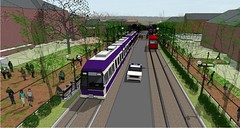
Purple Line Route DetailAlthough its construction is years away, today a debate is raging in College Park that will determine where the Purple Line light rail link between New Carrollton and Bethesda will run on campus. (Detailed route) For years, state planners with the Maryland Transit Administration (MTA) have discussed running the line through the heart of campus, where hundreds of university shuttles and other buses run daily, discharging their passengers in front of the Student Union just steps from the major campus buildings. This Campus Drive alignment maximized access to campus as well as passing through campus efficiently.

Purple Line 5High level university administrators, led by University President Dr. Dan Mote, have been less enthusiastic. Just before a MTA briefing in College Park on the project and after months of silence, Mote broke his silence. He declared in an op-ed in the student paper in October that the university would support the project—on the condition it would be routed on an alternate alignment at the north end of campus along a road called Stadium Drive shown in orange above. At the MTA briefing, state officials argued they thought Campus Drive was the best location for the line, presenting these renderings as well as a variety of data about what the effect of the line would be.

Since then, the student paper has published three student editorials, one a half by myself, supporting the Campus Drive alignment as well as a staff editorial critiquing Mote’s proposal. Meanwhile, on Rethink College Park we have broken down the various proposals in gritty detail with over 100 community comments in the past two weeks, and launched a Facebook group dedicated to the issue.

Nonetheless, administrators are pressing on in their quest for a circuitous northern route that gives the transit engineers headaches. Last week Mote spoke to the undergraduate student government about his plan, and this week bringing their case to the university’s Faculty Senate. The debate will continue on campus Friday as the Graduate Student Government will consider a resolution supporting the Campus Drive alignment. State planners will return to College Park in December to present the results of their study of alternate routes for the trains on campus. According to the current project schedule, the state hopes to finalize the route by next spring, to use to apply next year for federal funds for the project.

Will the Purple Line eventually have a stop in front of the student union, as pictured in the MTA image below? For now, it’s unclear, and the conversation continues on campus in advance of the next MTA meeting. Care to join a Facebook group?

Purple Line 7


Research Help

Posted: October 15th, 2007 | Author: Rob Goodspeed | Filed under: Light Rail, Urbanism | 10 Comments »

I am doing some research and hope some readers here can help. I’m looking for:

  • Examples of low to moderate density residential neighborhoods connected by a street grid to moderate density retail or mixed use districts. Neighborhoods near busy roads and with high income levels would be a plus.
  • Example track cross sections and other detailed alignment data for modern light rail lines operating on narrow right of ways. Data including station dimensions would be best.

These requests are related to my work with the University of Maryland East Campus project, and both will be explained in depth on Rethink College Park.


Light Rail’s American Moment

Posted: August 6th, 2007 | Author: Rob Goodspeed | Filed under: Light Rail, Transportation, Urban Development | 11 Comments »

Which U.S. city has spent over $400 million to begin construction of an approved transit system of over 50 miles of rail lines? What other city recently kicked off a $6 billion project to build over 100 miles of new commuter and light rail, nearly quadrupling the size of the existing system?

Charlotte, North Carolina and Denver, Colorado are just two of the unlikely U.S. cities that have made major moves to invest in rail-based public transit recently. In Charlotte, the LYNX Rapid Transit Services will be the first major light rail system in the state when it opens this winter. The product of decades of planning, the system is being linked with re-zoning to accommodate increased density at the route’s stations, and is being tightly linked to other forms of transit. The first line’s Siemens rail cars, seen to the right, are already purchased and undergoing testing. Here’s a map of the approved system:

Charlotte Light Rail Plans

In Denver, after an initiative to expand the existing light rail system failed in 1997, advocates built relationships with nonprofits, businesses, and local governments in the region, holding dozens of community meetings and refining plans. The aggressive community outreach efforts paid off: in November 2006, the multi-billion dollar FasTracks proposal passed and the expansion plans shown on the map below are well under way. (The completed system will have more miles of track than the D.C. Metro) Also below, the photo shows a train pulling into downtown Denver.

Denver Light Rail System

Substantial investment in transit is popping up in other unlikely places.

Phoenix, Arizona is constructing a 20-mile light rail line that passes through Mesa, Tempe, and downtown Phoenix. The initial segment is estimated to cost in excess of $1 billion and will open in 2008, and work has begun to plan additional extensions.

Phoenix Light Rail

Salt Lake City has spent $520 million on a 19-mile system, and voters have approved billions more to double the size of the system. According to the New York Times, the ridership on the system of more than 55,000 a day is exceeding ridership projections.

In Los Angeles, officials have spent billions enhancing public transportation. The Pasadena Metro Gold Line opened in 2003, an Eastside extension will open in 2009, and planners hope yet another line will receive funding. Here’s a map of the current system, which includes light rail and a subway:

LA Rail Map

Houston opened a light rail line in 2004, and San Diego opened an expansion of theirs in 2005. Last November, after years of defeating similar measures, sprawling Kansas City, Missouri approved a sales tax to construct a light rail system, and planning is moving forward on the BeltLine proposal that would encircle Atlanta and link to that city’s MARTA system. In the Washington, D.C. region, new rail projects are still in the planning stages. Although state officials delayed applying for federal funds until next year, with a pro-transit governor supporters are optimistic the D.C.-area Purple Line will finally go forward. Planning is underway for streetcars along Arlington’s Columbia Pike as well as the return of streetcars to D.C. streets.

To be sure, significant challenges face public transit in these cities, and even when this investment transit will remain practical for too few commuters. Additionally, dense development at transit stations can take decades to materialize, and the systems can be expensive to operate and maintain. Nonetheless, many of these systems are substantial, metropolitan-wide systems connected both to other transit modes and activity centers, and will create a real alternative to driving for many.

Links
> Charlotte Area Transit System
> Charlotte Observer: “The Other Argument for Light Rail
> Denver Regional Transportation District - FasTrack Project
> ValleyMetro (Phoenix)
> Utah Transit Authority
> NYTimes: A Rail Line Drives Development in Utah
> The Atlanta BeltLine Partnership
> Kansas City Regional Transit Alliance
> Light Rail Now!