Urban neighborhoods across America have a “parking problem.” Free curb spaces are hard to come by during busy times, especially in commercial areas. Because curb spaces are so much cheaper than garages, drivers continue to cruise for spaces. That’s the reason one of the major recommendations of parking reformers like Donald Shoup is raise the price of on-street parking, particularly in commercial districts. (I’ll discuss his proposals for residential neighborhoods later.) In their view, the “shortage” of on-street spaces results because the spaces are underpriced. As a result, drivers cause huge amounts of wasted time, fuel, and unnecessary traffic. These spaces should instead be priced high enough to ensure a few empty spaces at all times. During peak periods parking would be expensive, but at other times it would be much cheaper or even free.
In response to my recent post on Donald Shoup’s High Cost of Free Parking, one commenter asked “isn’t the curb thing just regressive taxation, discriminating who can shop downtown by income?”
While the economics of the proposal is straightforward enough, the ethics aren’t. Would performance-based meter pricing hurt the poor?
The weekly newsletter circulated by my representative on the D.C. Council, Jack Evans, contains this personal plea for community members to attend an upcoming zoning hearing regarding a mixed-use redevelopment of the O Street Market:
O Street Market needs support from residents
The DC Zoning Commission will hold a Public Hearing on the O Street Market project on March 6 at 6:30 pm at the Zoning Commission Office, 441 4th Street, NW Suite 210S.
“I am personally asking those concerned to show support for this important project in the heart of Shaw by attending this hearing,” Councilmember Evans said.
If you wish to testify, you can sign up at the meeting. For more information, contact the Office on Zoning at 727-6311 or Evans’ Shaw liaison, Windy Abdul-Rahim.
The site currently contains a Giant Supermarket, surface parking lot, and abandoned market structure. The developer is asking the Zoning Commission to re-zone the parcel from C-2-A to CR or C-3-C, commercial zones supporting higher density. The official notice generated by the zoning commission contains a description of the request and information about how to testify.
For more discussion of the project see my original post, or this interview where Roadside Development founder Armond Spikell discusses it with DCmud.
One topic of urban policy has come up again and again over the past year or so of my life: parking. A mild-mannered UCLA planning professor Donald Shoup is convincing more and more urbanists the key the reducing traffic and reforming the shape of our cities is to re-consider our parking policies. Although he makes his case in the intimidating, encyclopedic 734-page tome The High Cost of Free Parking, at its core his argument is quite simple.
Shoup thinks curb parking is too inexpensive. Rather than making parking accessible, he thinks low prices waste huge amounts of time and resources as motorists cruise for open spots. Raising the cost of curb parking to what is necessary to keep a few spaces open at peak hours will reduce traffic, increase turnover of this scarce resource, and bring in new tax revenue that can be used to directly improve the streets where it is collected. This thesis is creatively explained in this short film produced by New York’s Open Planning project.
Our zoning codes also require a certain number of off-street parking spaces for new buildings. Shoup critiques these requirements as a pseudo-science, complaining they are based on statistically dubious studies measuring “demand” for free parking in suburban locations. The cost of this parking, up to $35,000 per space, is almost never passed along to the parking users. Furthermore, the zoning requires parking to satisfy peak requirements, meaning it sits empty almost the entire year. In the aggregate, Shoup thinks the requirements are a total planning disaster: he argues they encourage auto use, damage the economy, degrade the environment, debase architecture and urban design, burden enterprise, prevent the reuse of older buildings, among a litany of other offenses. In Shoup’s view, “Off-street parking, far more than the interstate highway system, have spurred the dominance of the automobile.”
He concludes that “if cities deregulate off-street parking and charge the right price for curb parking, market forces will improve transportation, land use, the environment, and urban life.” While I think turning the requirements into maximums is a more pragmatic first step, it’s hard to reject his argument our policies should make parking users pay its full cost. Almost three years after its publication, the book’s sales seem strong: it is #2 American Planning Association’s list of bestsellers and among the top 100,000 titles on Amazon, no small feat for a $50 treatise on a mundane aspect of urban policy.
Reading the book inspired me to review what amount of parking region’s zoning codes require. The results of the survey are below, but I should make an important caveat. The codes can be extremely long and complex, making interpreting them difficult. Furthermore, many of the jurisdictions allow developers to reduce these requirements for certain districts of proximity to Metro stations, and almost everything in the zoning code can be negotiated through variances and exceptions. Nonethless, the findings seem to confirm Shoup’s complaint the requirements are inconsistant and excessive, especially if you consider each space required below could require up to 300 square feet of space in a parking structure and cost up to $35,000 or more.
How many parking spaces are required for different types of buildings?
Montgomery County
DC
Arlington
Alexandria
Single Family House
2
1
1
2
Apartment
1 to 2 per unit
1 to 4 per unit
1.125 per unit for the first 200, 1 per unit for the remainder
1.3 to 2.2 per unit
Hotel
0.5 to 0.7 spaces per room, plus 10 per 1,000 GSF of meeting space
1 for each 2 to 8 sleeping rooms, or in C-M, M 1 for each room usable for sleeping plus 1 for each 150 SF, whichever is greater
1 per room
1 per room, more than three stories 1 per two rooms
Office
1.9 to 3.0 per 1,000 GSF with variety of reductions possible
0 to 1 for each 600 SF beyond 2,000 SF
1 per 250 to 400 SF
1 per 450 to 600 SF
Industrial
1.5 per 1,000 GSF
1 for 1,000 GSF
1 per 1,000 SF or 1 per 2 employees, whichever is greater
Retail
5 per leasable 1,000 GSF
none for under 3,000 SF, beyond that 1 per 300 SF
1 per 250 to 300 SF
1 per 200 to 330 SF
However, in D.C. there is considerable interest in re-evaluating the parking requirements. The city has recently launched a major effort to undergo a comprehensive revision of the zoning code. As part of the process the Office of Planning has organized committees examining each aspect of the code, who will each hold multiple meetings open to the public. The documents used to kick-off the parking committee this week are online, and include an excellent summary of best practices in parking policy by the innovative firm Nelson/Nygaard.
Two upcoming projects in D.C. are also putting parking issues at center stage. The Washington Nationals Ballpark is set to open March 30th, and in response D.C. Councilmember Tommy Wells has proposed an innovative curbside parking management proposal that would implement the sort of policies advocated by Shoup. In Columbia Heights, the massive DCUSA project set to open March 8 and Councilmember Jim Graham recently called several hearings where new policies for the neighborhood were discussed. The brewing events mean 2008 could be the year for parking policy in Washington.
Since my original post on the topic way back in 2006, the D.C. urban and real estate blogosphere has evolved somewhat. However, only recently were there enough changes to convince me the topic deserved to be revisited.
I thought it fitting to use this Martin Luther King, Jr. Day to post a brief update about the memorial planned for the National Mall. Of course, Washington, D.C. already has one memorial to King — our public library.
The National Mall memorial location is at the north east corner of the Tidal Basin, just steps from where he delivered his 1963 “I Have a Dream” speech from the steps of the Lincoln Memorial.
The elegant design guides visitors through a “Mountain of Despair” into a semi-circular water wall inscribed with King quotes. A monumental “Stone of Hope” featuring a partial sculpture of King overlooking the Tidal Basin lies at the heart of the memorial. On the back side of the wall of quotes lies 24 niches along the upper walkway, some commemorating individuals who gave their lives during the civil rights movement, some remaining unfinished and undedicated, “deference to the unfinished nature of the movement.”
Twelve years since it was first approved by Congress, the private foundation overseeing the project continues to work with federal officials on finalizing the design. Despite a ceremonial groundbreaking in 2006 and an announcement one year ago that construction would commence last spring, the U.S. Commission on Fine Arts found plenty they didn’t like when a revised design was presented at their November 15, 2007 meeting. The noted the Mountain of Despair and the Stone of Hope had “grown since previous submissions” by several feet, described the paving as “inappropriately domestic,” suggested significant changes to the proposed floodlights, and requested the bookstore and restroom be reduced in height and size, among other criticisms. The commission requested a scale model of the Mountain of Despair and Stone of Hope, as well as samples of the stone, masonry techniques, and text and typography of quotes planned for the next submission.
The memorial foundation has started a construction blog where Executive Architect Dr. Ed Jackson Jr. will answer questions about the memorial’s design and construction. So far the only content is a post explaining their selection of a Chinese sculptor to create the Stone of Hope, a decision that has sparked some controversy among those who thought the honor should go to an African American or American sculptor. The blog hasn’t been updated since last March, so I hope it will resume once construction begins.
This fundraising video from the foundation building the memorial offers a glimpse of the ROMA Design Group’s winning design.
After completing my recent analysis of WMATA’s Metrorail fare increase, I decided to do some more research to better put the fares in a national context.
First, a took a look at how Metrorail compares with the nation’s other subway systems. As you can see, every subway except Philadelphia’s PATCO, San Francisco’s BART, and the D.C. Metro operate with a flat fare for all riders. BART and the D.C. Metro are the most expensive of all by far.
Next, I added the total system lengths as a rough measure of the distance and choices offered by each system. The big outlier here is the huge New York City Subway. Chicago’s CTA is roughly the same size as Metro, but generally cheaper at $2.00. (However it should be noted the CTA is in a financial crisis.) L.A.’s new subway is the cheapest of the group at $1.25.
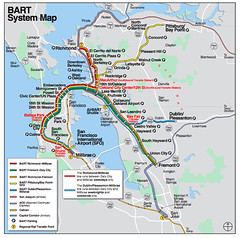
The D.C. Metro and San Francisco’s BART are often described as sister systems. They serve similar sized cities, were built at a similar time, and provide a similar type of service to their riders. They both also use a graduated fare system rather than a fixed fare. Like Metrorail, BART has recently adopted fare increases.
To complete the following analysis, for BART I used the 16th Street Mission station. For the Washington, D.C. fares I used the Shaw station. Both are residential neighborhoods located near the center of the systems, resulting in a good variety of destinations among the sample trips.
On the BART system, trips under 6 miles are fixed at $1.50, and longer trips vary according to length and where they run thanks to a variety of surcharges. (Airport trips are more expensive, for example.) Children, seniors, and the disabled receive a fixed 62.5% discount.
Here’s the result if you plot the regular fares from BART and Metrorail. For shorter trips, the two systems are roughly analogous, and for longer trips Metrorail is more expensive.
However, as the most interesting result comes by graphing the per mile cost of each fare. It seems the new BART and Metrorail fares are nearly identical per mile, and like Metrorail the longest trips on BART are quite cheap per mile.
Thanks to fellow Maryland community planning graduate student Matt Johnson, who helped me track down other system’s fares and calculated the BART station distances by hand.
After years of inaction, the process of re-constructing the D.C. Public Library’s Watha T. Daniel/Shaw Neighborhood Branch seems on-track. A new temporary library hums with activity, demolition of the old building well underway, and a meeting scheduled later this month to reveal a preliminary design for the new building.
Last October, a well-equipped temporary library opened on the grounds of Shaw Junior High roughly two years since the old Watha T. Daniel branch closed. The temporary library is equipped with a children’s section, periodicals, a number of public computers, and variety of books, and a visit this afternoon found a number of people reading, browsing the stacks, and surfing the web.
Library officials have planned a community meeting to unveil the preliminary design for the new library, to be held on Wednesday, January 30th at the interim library from 6:30 to 8:30 p.m.
For the last several weeks construction crews have begun the painstaking task of the careful demolition of the brutalist 1960s structure, revealed in the photos below to be heavily reinforced concrete.
March 2006
January 2008
March 2006
January 2008
While I haven’t visited recently, during a visit last August I found the system’s long-beleaguered Martin Luther King Memorial Library to be in the best shape I’ve ever seen it. All four elevators were in operation, which hadn’t happened in so long the Washington Post saw fit to report the news. The lobby was so clean and well-lit it reminded me of the historic photos I’d found from when the building just opened, perhaps fitting as the building was declared a historic landmark by the city last July.
Recent Comments