Posted: January 15th, 2008 | Author: Rob Goodspeed | Filed under: Urbanism, ePlanning | 1 Comment »
Planetizen has asked me for nominations for their annual list of the web’s top planning and development websites. Winners in 2007 included architecture blog BldgBlog, Arlington County’s Commuter Page, and the Lincoln Institute for Land Policy’s Visualizing Density tool. The criteria simply request sites that are a service to the planning community.
What sites should I nominate? What’s your favorite urban planning website?
Posted: January 3rd, 2008 | Author: Rob Goodspeed | Filed under: District of Columbia, Transportation, WMATA | 14 Comments »
With the D.C. Metrorail’s fares set to increase on Sunday, it piqued my interest in precisely how the system determines charges and the nature of the changes. I decided to take a look at exactly what pattern the famously unpredictable fares took. While most news reports have reported suburban riders would experience the largest absolute increases, my analysis shows they continue to enjoying the lowest cost per mile of all riders, well below the cost of automobile use.
First as a note, while I support minimal user fees for public transit, I don’t have much patience for those who complain about any fare increase. The costs of running Metrorail — especially employee health insurance and electricity — have increased exponentially in recent years. However, funding from the area jurisdictions has not kept up. The agency was left with little choice than to raise fares to make up the difference. While the best solution might be a stable dedicated funding source, forcing austerity by blocking face increases would only compromise the system’s performance and reliability in the long term. Tight municipal regulation of fares was one reason the nation’s urban streetcar systems fell into disrepair in the 1930s and 40s, making them prone to purchase and closure by automobile companies. At the very least, WMATA should be able to adjust fares to keep pace with inflation (something the December decision allows).
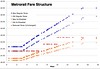
To create these graphs, I analyzed the current and new fares for my home station, the Shaw-Howard University station on the Green Line. This set includes some trips that clock out at the new maximum fare — $4.50.

The fares operate at a flat rate until the trip reaches about 3 miles in length, and then progressively increases until it reaches about 15 miles, where it remains at a maximum fare. The reduced (off-peak) fares are divided into three tiers, and will remain unchanged under the new plan.
While this graph makes it look as if urban riders are getting a subsidy and suburban riders must bear a high burden, a quick look at the fares per mile shows a quite different pattern.

Since most reliable estimates of the cost of operating an automobile range from $.50 per mile to $1.50 per mile, we can see most suburban commuters continue to enjoy costs substantially lower than driving if we exclude the more complex issue of speed. All this goes to make former WMATA Board Member T. Dana Kauffman’s claim the fare structure is a “raw deal” for suburban commuters all the more absurd.
Lastly, riders are familiar with the system’s estimated trip times, presented alongside the fares in stations and online. These times take into account train frequency and the number of transfers required. While I’m not sure exactly how they are created (and assume they mean peak times), I’ve found them to be roughly accurate. Using this data I have graphed the average trip speeds from the Shaw station.

What do you think of the fare system and the increases?
> W. Post: Metro Passes Largest Fare Hikes in its History, Increases in Fares, Services Unequal
> WMATA: New station-to-station fares
Posted: January 2nd, 2008 | Author: Rob Goodspeed | Filed under: History | No Comments »
I’m attending the American Historical Association Conference this weekend, held in the Woodley Park hotels here in Washington, D.C. A list of the sessions I’m thinking of attending is below, and the asterisked ones I’ll be at for sure.
Readers may also be interested to know I’ve also applied to five PhD programs to start next fall. They are programs in history at University of Pennsylvania, University of Maryland, Northwestern and the University of Michigan, and also to the HASTS program at MIT.
Thursday, January 3
3:00 - 5:00 p.m.
Teaching Urban History
Friday, January 4
9:30 - 11:30 a.m.
Historicism and Its Limits
Tech Tools for Historians
The People’s House Roundtable
Managing Everyday Risks in the Twentieth Century: Pedestrians, the AUtomobile, and the Enclosure Movement
* De Facto Segregation: Regional Fallacies, Racial Myths, Historical Practices (M. Lassiter)
2:30 - 4:30 p.m.
Closing the “Passion Gap”
5:30 - 6:30 p.m.
Graduate Students Forum
Saturday, January 5
9:00 - 11:00 a.m.
* Hurricane Katrina and the History of Disaster (L. Vale)
Economic History of the Book in the US
11:30 a.m. - 1:30 p.m.
Learning to Teach: History Education for the 21st Century
2:30 - 4:30 p.m.
* Secure … for Whom? Campus Violence in Historical Perspective, from the Bell Tower to Blacksburg
Sunday, January 6
11:00 a.m. - 1:00 p.m.
* Historians Going Public: Taking History to Newspapers, Radio, TV, Film, Public Libraries, Web Sites, and Blogs