Public Involvement in U. of Maryland East Campus Planning

Posted: November 19th, 2008 | Author: | Filed under: College Park, ePlanning, Maryland, Public Participation | Comments Off

Tonight at an event at the MIT Department of Urban Studies and Planning I met Harry Mattison, the author of a blog about the Allston Brighton Community Blog. He’s also a member of the Allston Brighton Community Planning Initiative.

The map below sums up what’s happening in the neighborhood. Clockwise from the left, the red areas illustrate the neighborhood’s institutional land owners: Boston College, St. Elizabeth’s Medical Center, Harvard University, and at the bottom right Boston University. More than passive neighbors, most of these — especially Harvard through its Allston Initiative — have been expanding. The dots show existing and planned development projects. (For the initiated like myself, ABCPI’s old presentations provide an introduction.)

ABCPI_Presentation_Feb2006-1.pdf (18 pages)

All this development activity, much of it planned by none other than Harvard has resulted in a climate of antagonism and distrust in the community. Discussing these issues with Harry, I was reminded of the procedural elements to the East Campus Redevelopment Initiative in College Park, Maryland.

East Campus  M-Square ConnectivityWhen I first arrived on campus in College Park to begin my master’s program in the fall of 2006, the University of Maryland was initiating the process of selecting a private developer to redevelop over 100 acres of their land into a mixed-use project with restaurants, apartments, a hotel, stores, and offices. The site is located just up the road from downtown College Park, strategically between the university’s main campus, and the Metro Station and University research park. (Yellow and green on the map to the right)

The administration had planned a three public forums about the project, complete with large maps and a panel to discuss the projects. Despite the preparation, turnout was abysmal and University staff easily outnumbered attendees. We requested and were granted a meeting with the then-Vice President for Administrative Affairs John Porcari and two other administrators to discuss public outreach about the project. Although they listened politely, the administrators firmly insisted the process of selecting a private developer must remain closed. Once one was selected, however, they pledged a full and public process.

That fall Porcari left the University to become the state Secretary of Transportation, but the next spring we had a meeting with one of the administrators from the original group and an expanded group including student leaders and administrators. At this meeting, we presented our recommendations for what a positive public engagement plan would look like. We argued it should be consensus-based, proactive, candid, and transparent, and provided specific recommendations and a brief summary of how other universities had handled input for facilities planning. The document is no masterwork, but because of it we brought far more substantive input than any other participant.

Shortly after that meeting, former Montgomery County Executive Doug Duncan was appointed to the position that would oversee the project planning, Vice President for Administrative Affairs. The veteran of a complex public-private project revitalizing Silver Spring, Maryland, Duncan was no stranger to the politics of urban development. I emailed him to congratulate him on his appointment, and asked for a position on any steering committee created.

During the summer, I received this letter from the University president:

July 20, 2007
Mr. Robert Goodspeed
AGNR-Plant Science & Landscape Architecture
2139 Plant Sciences Building
College Park, MD 20742-4452

Dear Rob:

With the recent Board of Regents approval of the team of Foulger-Pratt/Argo Investment as the developer with whom the University can negotiate a development plan for the East Campus site, I am seeking the input of a Community Review Steering Committee. The Committee will work toward achieving a consensus plan for the development of the University’s east campus site and toward promoting the revitalization of the Route 1 corridor. Planning for this project must provide for current institutional needs, future campus goals and the enhancement of the surrounding community.

The Committee will work in open session, considering issues that have been brought to it by the campus community, area neighborhoods and local businesses. Comment from the public will be solicited at public events and through members of the committee. We look forward to lively dialogue and a collegial exploration of ideas between our Committee members and the development team. Committee members will be charged to work with the Foulger-Pratt/Argo team on the development of the plan. They will be in a position to gain a high level of understanding of the project in order to provide input and to build broad support for it.

You have been recommended for membership on this Committee, and I ask for your participation. I hope that you will consider this opportunity to represent the community in this transformational planning process. I value greatly the input of our diverse community for the east campus development. I am excited by the long-term vision of a vibrant, mixed-use center that will serve the University and the College Park communities. I have attached the schedule of the meetings planned as you consider this invitation. Being optimistic, I would like to thank you in advance for agreeing to serve. Please contact [EXCERPTED] to confirm your availability and interest in helping to make the east campus a truly great contribution to our community.

Yours sincerely,

C. D. Mote, Jr.
President

The following schedule was enclosed.

East Campus Community Review Steering Committee
Tentative Meeting Schedule

Chair of Committee: Mr. Douglas M. Duncan
Vice President for Administrative Affairs
University of Maryland

The following is a tentative schedule for meetings and topics for discussion. All the meetings will be held from 7:30 p.m. to 9:30 p.m. in the Visitor Center Auditorium located in Turner Hall.

* August 13–Introduction; background on RFP process, developer presentation; committee goals/charge

* August 27–Market dynamics and proposed uses: retail, residential, office, and hotel

* September 12–Economic impact of development and public finance options

* September 24–Transportation planning: Route 1/Paint Branch connections/traffic calming, public transit, and pedestrian/bicycle connections

* October 8–Land use options and concepts: placemaking, street-facing retail, views, plazas, connections, and residential over retail.

* October 22—Concluding meeting

Although the precise timing and topics varied somewhat from this schedule (the meetings didn’t wrap up until January 2008, for example) it generally suggests the approach taken. After every meeting and at other times during the process I wrote detailed blog posts on Rethink College Park, sharing all the technical documentation and information discussed at the meetings. In general, these meetings were very well attended and despite tense moments were generally respectful. During the entire time period, me and the other Rethink College Park contributors wrote a staggering 366 posts about East Campus. The university posted a variety of information to their website about the project.

Chaired personally by Doug Duncan, the meetings were very good at sharing information and providing a venue for community engagement. However, they weren’t perfect. Here’s a few of my concerns:

  • The composition of the committee was half university, half community, with a few others (including 3 students) thrown in. If the university is a developer, why should they have such a large representation?
  • The format of the meeting was designed for one-way communication, not discussion. The group sat in a “U” facing a presenter. The only structured discussion was during Q&A.
  • No designs in more detail than massing and site plans were presented. This was the biggest failure of the process: nobody saw the public plans until after the group stopped meeting.

Last summer, I made one last trip to College Park to see the unveiling of the final plans, which were submitted to the county for approval last summer also. In addition to what’s described here, the project involved dozens of other components I haven’t mentioned, ranging from talking with members of the closed-door campus architectural committee to visiting with administrators to discuss how to make the project website more user-friendly. Needless to say, the true impact of any of this on the project is impossible to say and the final chapter of this project is far from over. Nevertheless, I hope the information here about the public process may prove a useful record.

> U. of Maryland East Campus Redevelopment Initiative (Official site)
> Rethink College Park: East Campus Posts
Rethink College Park: “Engaging the Community in the East Campus Redevelopment”
> See also, “NIMBYism, Urban Development, and the Public Involvement Solution,”


Rethink College Park Among Top Planning Websites in 2008

Posted: February 5th, 2008 | Author: | Filed under: College Park, ePlanning | 1 Comment »

The blog I co-founded about urban development issues in and around College Park, Maryland, Rethink College Park, has been named one of the web’s Top 10 Urban Planning, Design, and Development websites by the planning portal Planetizen. The award recognizes the hard work and support of all the site’s contributors and others who have provided assistance since our launch in July 2006.

The other winners include WalkScore, Trulia’s fascinating Hindsight tool, and the very slick (and new to me) Ourbania.


Debating Purple in College Park

Posted: November 14th, 2007 | Author: | Filed under: College Park, Light Rail, Maryland, Transportation | 7 Comments »

3 Alignments

For urban observers, it’s a rare opportunity to watch a major urban planning mistake being made before your eyes. We can only wonder “what were they thinking?” years later, when the project is complete and communities are left with the builder’s errors: dead-end highways, blank walls, and train stations far from where commuters need to go.

Purple Line Route DetailAlthough its construction is years away, today a debate is raging in College Park that will determine where the Purple Line light rail link between New Carrollton and Bethesda will run on campus. (Detailed route) For years, state planners with the Maryland Transit Administration (MTA) have discussed running the line through the heart of campus, where hundreds of university shuttles and other buses run daily, discharging their passengers in front of the Student Union just steps from the major campus buildings. This Campus Drive alignment maximized access to campus as well as passing through campus efficiently.

Purple Line 5High level university administrators, led by University President Dr. Dan Mote, have been less enthusiastic. Just before a MTA briefing in College Park on the project and after months of silence, Mote broke his silence. He declared in an op-ed in the student paper in October that the university would support the project—on the condition it would be routed on an alternate alignment at the north end of campus along a road called Stadium Drive shown in orange above. At the MTA briefing, state officials argued they thought Campus Drive was the best location for the line, presenting these renderings as well as a variety of data about what the effect of the line would be.

Since then, the student paper has published three student editorials, one a half by myself, supporting the Campus Drive alignment as well as a staff editorial critiquing Mote’s proposal. Meanwhile, on Rethink College Park we have broken down the various proposals in gritty detail with over 100 community comments in the past two weeks, and launched a Facebook group dedicated to the issue.

Nonetheless, administrators are pressing on in their quest for a circuitous northern route that gives the transit engineers headaches. Last week Mote spoke to the undergraduate student government about his plan, and this week bringing their case to the university’s Faculty Senate. The debate will continue on campus Friday as the Graduate Student Government will consider a resolution supporting the Campus Drive alignment. State planners will return to College Park in December to present the results of their study of alternate routes for the trains on campus. According to the current project schedule, the state hopes to finalize the route by next spring, to use to apply next year for federal funds for the project.

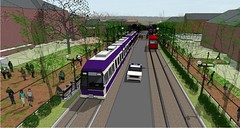
Will the Purple Line eventually have a stop in front of the student union, as pictured in the MTA image below? For now, it’s unclear, and the conversation continues on campus in advance of the next MTA meeting. Care to join a Facebook group?

Purple Line 7


Mapping Development in College Park

Posted: February 23rd, 2007 | Author: | Filed under: College Park, Maryland, Public Policy, Technology, Urban Development | Comments Off

Today at Rethink College Park we launched an interactive Google Map of all the various development projects we have written about so far on that website. It also serves as a graphical index to the site, since each point is linked to a page containing all our posts on the project.

While it’s not as robust as some of the sophisticated GIS systems used by more forward thinking governmental agencies (see the City of Alexandria’s development viewer), since we developed it in a few days at no cost, I’m pretty happy.

> Rethink College Park Development Map


Blogging for Engagement in College Park

Posted: January 31st, 2007 | Author: | Filed under: Blogosphere, College Park, Maryland, Urban Development | Comments Off

Can a blog help bring new participants to the planning process? We’re not sure, but we’re trying. Two recent articles describe the progress we’ve made since launching Rethink College Park six months ago. The first is from today’s edition of The Diamondback, the campus student newspaper.

When then-graduate student Brian Carroll defended his thesis on redeveloping the Knox Box area last month, he never expected the debate to travel beyond a committee of professors.

But once the local development blog Rethink College Park got wind of his work, posting Carroll’s drawings and ideas to revamp the aging neighborhood populated with students, the comment section came alive with interest. The attention highlighted the push for student housing development downtown and the propensity online forums have for facilitating discussion, but Carroll expressed surprise at the reaction.

“I think the thing that they did was pull it all together,” Carroll said of the Rethink College Park editors. “I could’ve completed my thesis and put it on the shelf in the library, but that got it some publicity.”[...]

But if the interest in Carroll’s work once posted on the Internet and the exchange of ideas since the blog’s launch are any indication, Internet discussions could be the future of public discourse here. That doesn’t mean city council meetings will ever cease, but council member Bob Catlin said with his constituents becoming increasingly busy, communicating with them electronically has become a major convenience.

> Diamondback: “City officials, students take talks to the Web

Second, this article co-authored with the site’s other editor, David Daddio, recently appeared on the website Campus Progress. It offers a good overview of the project and the context here on campus.

” … Our single-minded focus on helping transform College Park into a great college town has led to discussions on the site about a host of progressive issues … With many institutions interested in building or expanding college towns near their campuses, students are in a unique role to ensure the development agenda includes what they value, whether it is sustainable design, affordable housing, socio-economic diversity, or the protection of small businesses. We believe students should be actively engaged in the design of their campuses and towns, and a website can be an effective tool to build a group of like-minded students and share knowledge about what is happening in your community. … “

> CampusProgress.org: “From Parking Lot to College Town?


Rethinking College Park: An Update

Posted: January 6th, 2007 | Author: | Filed under: Blogosphere, College Park, Politics | 1 Comment »

Things have been kind of quiet around here lately for a couple reasons: I just successfully wrapped up my first semester of graduate school, and because most of my blogging energy has been dedicated to Rethink College Park, a new community website I am involved in.

Readers of this website may be familiar with the general concept of the site I described in May, or perhaps may have seen the announcement I posted after we launched last summer. However, I have said little about it since then.

In short, things are going very well. We summarized some of our accomplishments in December: we have averaged over 100 visitors a day (In a city of 25,000), published 95 posts and over 200 comments. Our posts have included everything from thoughtful essays on urban design, obscure documents we dredged up about controversial projects, and examinations of a secretive University-led development project. Most recently, we have posted detailed candidate surveys for an upcoming special election to fill two vacancies on the city council.

Furthermore, we have begun to build the infrastructure to make the effort sustainable in the long term. We have identified as a major goal for next semester as recruiting more writers and leaders for the organization. Although it is difficult to measure of the impact of the site, it’s clear that at the very least we are succeeding to create an open forum for the entire community — our first and primary goal.

To top it off, I just found out today we are the top hit if you google “I want to run for city council.” Either we’re doing something right, or there is a sore lack of this type of information on the web!


Rethinking College Park

Posted: August 14th, 2006 | Author: | Filed under: College Park, Urban Development | 2 Comments »

Click here to visit the new blog Rethink College Park.

In May I blogged about an interesting op-ed published in the University of Maryland student newspaper written by Maryland undergraduate David Daddio. Although College Park is the home of the University of Maryland’s flagship campus with almost 35,000 students and has its own Metro station on the D.C. subway, the “city” is limited to a run-down stretch of U.S. Route 1 near campus and few strip malls. In recent years a consensus has emerged among students and community leaders in College Park that the city should strive to become a better “college town.” At the end of the school year the student government even sponsored a design brainstorming session with the architecture school about how the city could grow. Despite all the interest, development has been uneven in the city: zoning decisions are controlled by county officials with other priorities, students are disconnected and ill-informed, and University administrators are often not engaged with community concerns.

David’s op-ed proposed a website that would function as “an ongoing public participation venue where students and city residents can be educated, debate the merits of projects and voice opinions.” When I got in touch with David to talk to him about my work with Arborupdate and DCist and offer to help in the effort, we decided to collaborate on a new site. Thus, today I’m happy to announce the beta launch of Rethink College Park. Our visionfor the blog is similar to what his original op-ed proposed: to connected stakeholders and encourage a “walkable, inclusive, and dynamic city.” We’re actively looking for event planners, graphic design people, writers, photographers, and just about anybody interested in helping, so please drop me a line if you want to get involved.

> Rethink College Park

Blog Widget by LinkWithin