Posted: August 22nd, 2008 | Author: Rob Goodspeed | Filed under: District of Columbia, Urban Development, Virginia | 4 Comments »

In a splashy cover story this week, the quarterly magazine sent to thousands of local business leaders this week considers which Washington, D.C. neighborhoods will be the next “hot spots.”
The story appears in OnSite, a quarterly glossy magazine sent to subscribers of the Washington Business Journal. With a password-only website, the story’s only readers will be the 16,600+ subscribers who pay over $100 a year to receive the weekly newspaper.
Featuring incendiary graphics (above) and a map with the neighborhood identified with crosshairs, the article will do little to sooth the concerns of activists fearful their neighborhoods will be targets for new development with or without their input. Surprisingly, only 4 of the 13 are within the boundary of D.C., a sign of how much investment has happened in District neighborhoods and the barriers to additional development. In addition to the neighborhoods shown on the map below, the magazine additionally identified Gaithersburg and Laurel in Maryland and Occoquan in Virginia.

The article proposes a number of variables to predict where people “want to live, work and hang out.” They are: accessible to roads, near Metro or other rail, near water or riverfront, geographically distinctive, near parks and recreation, near anchor or stadium, upward economic capacity, arts uses, main gathering place, historical features, interesting architecture, and pedestrian oriented.
The most surprising locations may be Landover (picked due to the ongoing Landover Gateway planning effort), Greenbelt (which we covered on Rethink College Park), and Prince William County’s Occoquan.
Occoquan? Despite being over 20 miles from Washington, OnSite thinks the tiny historic town’s proximity to to I-95, several VRE stations, Fort Belvoir and Quantico bases, nearby “smart-growth style developments,” and attractive waterfront will make it a hotspot for growth.
What do you think of their picks? What places — or factors — are missing from the analysis?
Posted: April 9th, 2008 | Author: Rob Goodspeed | Filed under: Rosslyn, Urban Development, Virginia | 6 Comments »
Last Saturday I competed in second annual Real Estate Case Competition hosted by George Washington University’s Real Estate Investment & Development Organization. Sixteen universities created interdisciplinary teams to create detailed redevelopment proposals for a site in Rosslyn, Virginia slated for redevelopment. The property owners, Vornado/Charles E. Smith, participated in the judging of the entries and contributed funds to host the competition and award the winning team a cash prize of $15,000. On Saturday, six of the top teams gave 40 minute presentations to a panel of judges from the real estate and planning community. Although every team had impressive presentations, our team took first place, the University of Virginia second, and Columbia University third.
Our University of Maryland team included Peter Mellen, Tyler Abrams, Eric Raasch, Tiffany Williams, and Malav Patel. Group members represented the Masters in Real Estate Development, Masters in Community Planning, and Masters in Business Administration Programs. Peter was the team leader and Tyler was responsible for the architectural renderings. The team is pictured to the right with one of our advisors, UMD Real Estate Development Program Director Dr. Margaret McFarland.
The site was located in Rosslyn, adjacent I-66.

We proposed a $1.5 billion development that would replace an aging collection of 1960s buildings with four new buildings, containing office, residential, retail, and a hotel.


Our proposal was not only profitable, but also contained an allowance for LEED Gold certification, a $19.6 million contribution to affordable housing, and other community amenities. We also proposed establishing a “Friends of Roosevelt Island Trust” to oversee the restoration of Roosevelt Island, which would be connected to the project via a new bike and pedestrian bridge over I-66.

A representative from the sponsor said they were preparing a real-life redevelopment proposal to present to county officials. After studying the site so intensively, I’ll be interested to see their proposal and what similarities it has with our design.
> UMD: “Real Estate Development Team Wins $15,000 First Prize“
Posted: October 30th, 2007 | Author: Rob Goodspeed | Filed under: Spotsylvania, Urban Development, Virginia | 10 Comments »
Founded as the seat of the federal government, the form of Washington, D.C. has always reflected security concerns. Since the sacking of the capital during the War of 1812, the government has taken increasingly extensive measures to ensure its self-protection, including 68 defensive forts during the Civil War, a beltway beyond the blast radius of an atomic bomb during the Cold War, and bollards and checkpoints today. Defense has often meant distance, and today geographer Deborah Natsios has observed the vast metropolitan region is embedded with “artifacts of the national security infrastructure” including communications equipment, defense contractors offices, and military facilities.
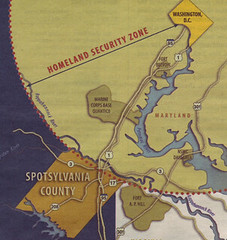
Now distant Spotsylvania County hopes to benefit from what Natsios terms ‘national security sprawl,’ boasting in a recent advertisement in the Washington Business Journal their county is the first jurisdiction along I-95 south of Washington, D.C.’s 50-mile Homeland Security Zone, near several military installations, and boasting offices meeting anti-terrorism requirements. Is the federal government pushing agencies and contractors to locate beyond 50 miles from Washington, or does the distance simply come as an added bonus to an exurban location? For now the issue is unclear. Information about the security zone on the web is scant, but the Washington Post reported a year ago about federal agencies quietly snapping up offices in Winchester, Virginia, which local boosters quickly noted was 75 miles from Washington, well outside the nuclear “strike zone.” The newspaper even helpfully printed a diagram illustrating just where such a boundary falls. Regardless of the precise nature of the cause, it seems security concerns are pushing government facilities into a new frontier far beyond the existing metropolitan area. Needless to say, the trend runs counter to local government efforts to cultivate smart growth in existing urban areas in order to economize on infrastructure and protect environmental quality.
There is some evidence Spotsylvania’s hopes to capitalize on security sprawl is coming true: the Census estimates the county has added some 30,000 residents since 2000, bringing their population to some 120,000. Capital Region urban observers may want to begin to study the names of a new ring of suburban counties.
> Previously: D.C.’s National Security Sprawl
> Washington Post: “New Rural Sales Pitch: Work Outside D.C.’s Fallout Zone”

Posted: May 21st, 2007 | Author: Rob Goodspeed | Filed under: Housing, Parks, Urban Development, Virginia | 3 Comments »

I completed this essay for the final assignment for my urban design class. The assignment was to conduct an analysis of this block adjacent the Ballston Metro Station in Arlington County, Virginia. My study area is part of the “Ballston-Rosslyn Corridor,” a nationally-known example of smart growth. Along the corridor, the county has added roughly 40,000 residents, 20 million square feet of office, and one million square feet of retail — with only a negligible increase in automobile traffic, thanks to bus and Metrorail use.
In the Virginia suburbs of Washington, D.C., adjacent the Ballston Metrorail station stands a collection of buildings far taller than any in the national capital. Reaching 10, 15, even 22 stories into the sky, these buildings contain offices, shops, apartments, and a hotel. Unlike most cities, however, this compact urban node has sprung out of the ground in just twenty years. 17 of the 19 buildings nestled in the area’s roughly 20 acres were completed since 1980. (fig. 1)

Nothing existing here before anticipated the scale and character of the development. The two oldest buildings in the study area are at an entirely different scale than the new construction. The surrounding neighborhoods of single-family homes and garden apartments have different lot sizes, street widths, and building rhythm. County officials and private builders have chosen to deviate from the established urban patterns, deliberately striving to knit together new development into a new urban texture. All of the buildings here were developed under specific zoning adopted in 1979 in response to the construction of the train station. While this zoning has evolved somewhat since its first adoption, the rapid development of the area creates an intriguing case study in the urbanity created by a specific set of polices and standards. While boasting clearly urbane aspirations, the collection of buildings has not created a coherent urban space. My analysis falls into three categories: the area’s poor street void definition, lack of an open space hierarchy, and its streetscape inconsistency.

A coherent urban space depends on a clearly defined street form. Considering the building footprints alone, in surrounding neighborhoods the streets are clearly defined by rows of single-family homes. (fig. 2) This system of what William C. Ellis has called a structure of voids. Moving to the study area the structure of voids transitions to a structure of solids, where each building has a unique shape, only loosely related to the adjacent streets. In order to visualize the structure of voids for the study area a rough, three-dimensional sketch was created. (fig. 3) The illustration depicts highly variable street spaces, quite distinct from the regularity in traditional urbanism. The visitor navigating these streets perceives the unfolding of a variety of spaces among buildings, not a street with a clear definition, beginning and end.

To determine the cause of the irregular distribution of public space we must examine the underlying structure of the district. The study area’s 24 lots range in size from some similar in scale plots intended for a single-family home, to lots large enough to encompass an entire city block. (fig. 4)

When developed under Arlington County’s zoning code, this variable underlying structure has profound design implications. The area’s zoning (C-O-A) requires 10% of the total site area for each building be landscaped open space. This provision guarantees the public open space will be found heterogeneously distributed throughout the area as each developer negotiates with county officials about what 10% portion of his lot will become public. In some areas this space has been coordinated to create larger courtyards, but the locations of these courtyards must be opportunistically located at the intersection of similarly sized lots. The result is a proliferation of awkward, ill-used open spaces, instead of the creation of larger, more coherent spaces. (fig. 5)

The proliferation of landscaped space drains the potential vitality of the larger parks, which in another setting could perform the role as a district-wide focal point. An interesting counterpoint to the success of nearby Market Commons in Clarendon. This mixed-use complex contains most of the public space in the area, and sits just off a street that has been intensely developed creating a continuous street wall. (fig. 6) While the public spaces in Ballston were sparsely used on a recent visit, the Clarendon Commons was bustling with activity. Of course, the success of the spaces is also related to the distribution of commercial space – in Ballston it is concentrated in the large mall.

Finally, county regulations also translate the variable lot sizes into a variable streetscape. In order to incentivize lot consolidation and the construction of apartments, the C-O-A zoning creates a hierarchy of allowable building heights depending on the primary use of the building and the lot size. Taller buildings can be built on larger lots, and apartment buildings can be built taller than office buildings. The result has been buildings over a considerable range of heights (fig. 7)

Combined with the open space requirement, the result of the regulations is buildings of highly variable heights and configurations. Despite text expressing the county’s desire to cultivate street level retail, the policy regime creates an irregular streetscape both at the pedestrian scale and building scale. Lastly, the zoning code’s parking requirements mean the buildings contain over 7,000 parking spaces. While for the most part these spaces have been cleverly embedded into the buildings, the car entrances and exits create additional interruptions to the street level fabric. (fig. 8 )

Although the district does not create the fabric of traditional urbanism, it cannot be said to be a failure. Meandering among the buildings, the visitor is invited to discover new urban spaces and stores and restaurants in unexpected locations. The city builders have achieved extremely high density in a highly landscaped, almost peaceful setting. While deviating from the traditional urbanism they espouse, their insistence on public landscape surrounding every building has created an alternate system, perhaps not unlike the landscape urbanism described by theorists like James Corner. As we leave Ballston, it must be noted this is an immature landscape in urban time. Only time will tell how its remaining underdeveloped parcels will evolve. Perhaps in that time the many young street trees (fig. 4a, 4c) will mature, and the landscape itself play an increasingly important role in defining more clearly the urban fabric.

Posted: April 8th, 2007 | Author: Rob Goodspeed | Filed under: District of Columbia, Urban Development, Virginia | 1 Comment »
To Deborah Natsios, the September 11, 2001 attack on Washington ushered in a new epoch of national security sprawl. She traces the evolution of “war sprawl” in the region: the city’s circumferential Civil War forts, suburban WWII facilities, Cold War beltway and missile placements, and exurban defense industry office campuses.
In Natsios’ account, the September 11 attack “inaugurated a new chapter in a regional history,” extending far beyond the downtown security bollards. The attack transformed “sprawl’s unpredictable legacy of subdivisions, culs-de-sac, big-box retailers, parking lots, fast-food franchises and high-tech corridors” into a “battlespace” subject to aggressive home raids and panoptic schemes of advanced electronic surveillance.
Leftist jargon aside, the article’s history and intriguing graphics make it well worth a perusal.
> National Security Sprawl by Deborah Natsios, from Architectural Design, Nov/Dec 2005, pp. 80-85.
Posted: April 7th, 2007 | Author: Rob Goodspeed | Filed under: District of Columbia, Freeways, Interchanges, Maryland, Urban Development, Virginia | 6 Comments »
American taxpayers have spent trillions of dollars building freeways since the passage of the National Interstate and Defense Highways Act of 1956. This network of freeways has re-shaped American cities, and arguably impacted the economy and culture of the country. While some enthusiasts find interest in the highway system’s endless strips of asphalt, for most the only true drama within the system is contained in freeway interchanges, where one or more freeways intersect. Although designed by traffic engineers, interchanges can contain dramatic ramps and intriguing shapes from above. One artist even took inspiration from the world’s freeway interchanges to design a set of tiles featuring their shapes.
Of these highways, Washington, D.C.’s Capital Beltway is among the more famous, as a symbolic dividing line between the national capital and the rest of the country. Let’s take a look at some of the interchanges in and around the beltway, to see what they reveal. We will approach the city from the north on Maryland’s I-270. Here, that highway branches in two as we approach the beltway.

If we travel East on the beltway we come across this interchange near College Park where I-95 intersects the beltway. Original plans for Washington’s freeway system included an extensive network of urban freeways that were never built — this interchange was designed to accommodate a never-built leg of I-95 extending to the District. Today, University of Maryland officials are advocating a freeway connecting this interchange to their campus.

As we continue along the beltway we come to this recently rebuilt interchange between the Capital Beltway and Route 50 in Prince George’s County. This photo shows the close relationship between Washington’s freeway and Metrorail system. From the very beginning the systems were designed somewhat in tandem and the train was intended to carry visitors into the city after arriving this far by auto. Here, special onramps connect the beltway to the New Carrollton Metro Station.

Continuing around the beltway we encounter the Springfield Interchange, one of several interchanges around the country known popularly as “The Mixing Bowl.” Here the beltway intersects both I-395 and I-95, and the interchange was long one of the most dangerous stretches of the beltway. In 1999, the Virginia Department of Transportation began an 8-year project to re-design the interchange in a project that is currently estimated to cost in excess of $670 million before it is complete.

As we continue around we come to the last I’ve selected for inclusion — this interchange where the beltway meets Route 50/Arlington Boulevard.

Interchanges Elsewhere
Interestingly, perhaps because of the investment in Metro, the scale and number of the freeway interchanges in the region is not notable from a national perspective. This image of the Big Dig in Boston gives a good idea of the scope of that project.

Unlike Washington, the city of Detroit did actually construct the entire network of urban freeways planned for that city, including some truly massive interchanges like this one, between I-96 and the Southfield Freeway.

Much more is written about interchange design and the Washington region’s freeways elsewhere on the web, so I won’t go into detail here. What am I missing? What is your favorite (or least favorite) interchange in the region?
References
> Scott M. Kozel’s Roads to the Future (Transportation history for VA, MD, DC)
> Kurumi’s Field Guide to Interchanges
> Springfield Interchange Improvement Project
> Google Earth Community: Crazy Highway Interchanges thread
Posted: January 31st, 2006 | Author: Rob Goodspeed | Filed under: Urban Development, Virginia | No Comments »

As promised, I checked out a DC memorial to the 1970s I notice every time I cross the 14th Street bridge to Virginia. What icon is that? Why, the Crystal City Doubletree’s rotating lounge, of course. In an earlier era it seemed no self-respecting city lacked a rotating restaurant, preferably lodged high up in a futuristic tower. While I don’t know much about its history, what I found about it on the web wasn’t promising: DC’s only rotating lounge had almost no footprint on the web save one critical Post review from 1998. However, I set out on my adventure optimistic as I had read the hotel had been recently renovated, starting with my destination: the Skydome Lounge.
Getting there would prove a bit of a challenge. From my house in Shaw I walked to the Convention Center Station to hop a Yellow Line train. When I plugged the address into WMATA’s trip planner it suggested I get out at the Crystal City Metro Station. At the station I walked under Route 1 and took a right on S. Eads Street. (Check out an area map.) After about half a mile of walking by condos and hotels I came to 12th street and could see the hotel. Although I perhaps naively expected an entrance, this hotel is a thoroughly auto-based affair: pedestrians have to walk up to the carport along a skinny sidewalk. Once inside, it was anything but clear where to go next. The hotel has had a major makeover and the main second floor lobby has its own bar as well as meeting rooms. Signs located near the elevator bank said nothing of the Skydome, but a hotel directory said it was accessible by the elevators in the North Tower. The front desk attendant told me I would have to take a specific elevator to reach the lounge, pointing me down the correct nondescript hallway and telling me to take elevator three.
Entering the lounge the first thing I noticed was the view, which is quite worth the hassle getting there. The perhaps 300-degree panorama provides good views of Rossyln, the Pentagon, and National Airport. The National Cathedral, Lincoln and Washington Monuments, and Capitol Dome are all also visible. Not to mention beautiful I-395. The second thing I noticed was a mild yet distinct dank odor. It was as if the Skydome needed a good airing out, but then again most 34-year-old bars take on an odor. The smell aside, the decor was new: small tables were stylishly set, flat screen TVs broadcasting ESPN and halogen track lighting. After taking a seat we remembered this was a rotating lounge, and realized that the floor where the tables were arranged was slowly rotating. (At the rate of one revolution every 47 minutes, our server informed us.) The menu seemed to be a selection from the hotel’s kitchen and included a wide variety of basic fare. (No happy hour specials here — two Buds set us back $10) The clientele seemed to be almost exclusively hotel guests — a couple, several businessmen, a group of conventioneers. The menu informed us the bar is open daily at 4:30 and on Friday and Saturday has a $5 per person cover charge. Also on Fridays and Saturdays the space hosts the “Windows Over Washington” restaurant, which we can’t find much information about.
Getting back to the Metro I took another tack, cutting through a vacant lot on a mysteriously paved and lit walkway to reach 12th Street by the Pentagon City Metro stop. While much more direct than coming from Crystal City, the walk would still be a bit far for a drunken stumble. So, what’s the verdict? The view means the spot would be unmatched in DC to watch a sunset or wow a date with a romantic skyline. Yet architectularly, the space comes across as exactly what it is: a 1970s marketing gimmic showing its age. The smell and supplies and beverage cooler placed awkwardly near the elevator did little to add to the charm. The difficult location also makes for challenging logistics for all but the most intrepid urban explorers. There are other much more accessible panoramas — from Sequoia in Georgetown to Tabaq on U Street — to warrant anything beyond an ironic suburban sojourn to the Skydome.