Posted: April 25th, 2008 | Author: Rob Goodspeed | Filed under: Climate Change, Smart Growth | 3 Comments »
This Tuesday I attended the “Earth Day Rollout” of a new book detailing the relationship between urban development and climate change.
Intuitively, it would seem logical to conclude that compact cities release less greenhouse gasses on a per capita basis than low density ones. We might hypothesize compact cities shorten distances between destinations, encourage walking and biking for short trips, and encourage public transportation use. It may also be more energy efficient to heat and cool the housing in more compact cities.
Amazingly, many scholars disagree. Just one year ago UCLA professor Randall Crane stated on his blog “how discretionary land use decisions can best address global warming is virtually unknown.” Crane is co-author of a 240-page research survey on the relationship between urban form and travel. At the root of the issue is the difficulty of disentangling person preferences, culture, and the physical environment. Even if urban residents use much less energy per capita, it may be because of socio-economic or so-called “self selection” factors. This scholarly ambivalence has left the planning profession at the sidelines of the global warming debate.
Despite a striking cover on last September’s Planning magazine (found in the mailboxes of most American urban planners) the articles inside were sadly disappointing, with few meaningful strategies presented. As a sign of the profession’s state, one reader wrote in to complain “other theories also explain the same observed data,” contrasting modern global warming theory with urban renewal theories of the 1950s. Another letter expressed disappointment over the lack of an article summarizing recommendations about what to do.
There are signs this is changing. A draft policy guide currently being considered by the American Planning Association on climate change features as its first two policy findings that land use patterns play a “significant” role in reducing vehicle miles traveled (VMT), and that parking and transportation policies can be employed to “discourage” private auto use.
This is precisely the case Ewing and his co-authors make in Growing Cooler. In essence, they argue that even if alternative fuel vehicles are phased in aggressively and the gas mileage of vehicles is increased to 50 miles per gallon, the U.S. will be far from meeting its goal of reducing CO2 emissions. The reason is that travel growth is expected to continue to grow rapidly along with rising population and economic growth. They find that people living in compact neighborhoods drive roughly 20 to 40 percent less than the residents of sprawling areas. They define compact neighborhoods by five criteria — the five D’s — density, diversity of land uses, design, destination access, and distance to transit. In the aggregate, a national smart growth policy could cut transportation CO2 emissions by 7 to 10%. Since transportation is only responsible for 33% of total U.S. CO2 emissions the role of Smart Growth is modest, but significant factor.
The authors point out compact development is a particularly attractive strategy to combat climate change because the emissions savings are permanent, it also results in public health and environmental gains, and may result in additional greenhouse gas savings through more energy-efficient homes. We know people buy smaller houses in compact communities, and even if the size of their units don’t decrease, row homes and condos are more energy efficient to heat and cool than freestanding homes. (Indeed, my neighbor told me his heating bill dropped significantly when our row house was remodeled after being vacant for many years.) Chapter 9 on “Policy and Program Recommendations” offers a wide range of suggestions, from a reformed federal transportation policy in the form of a “Green-TEA” law and national cap-and-trade system, to a variety of proposals at the regional, state, and local levels to create compact development patterns. I’m happy to see the very last proposal listed “Invest in Civic Engagement and Education.” Recognizing that “successful planning requires the meaningful engagement of people who live and work in the affected community,” the authors call on “planners and decision makers [to] actively seek out public input early in the planning process.” After all, under our urban planning system local communities have the biggest role to play determine the form of our cities. This book makes the case their decisions will play a critical role in our effort to combat global warming.
> ULI: Growing Cooler
> Smart Growth America: Growing Cooler: The Evidence on Urban Development and Climate Change
Posted: March 4th, 2008 | Author: Rob Goodspeed | Filed under: District of Columbia, Parking, Smart Growth, Transportation | 10 Comments »
Urban neighborhoods across America have a “parking problem.” Free curb spaces are hard to come by during busy times, especially in commercial areas. Because curb spaces are so much cheaper than garages, drivers continue to cruise for spaces. That’s the reason one of the major recommendations of parking reformers like Donald Shoup is raise the price of on-street parking, particularly in commercial districts. (I’ll discuss his proposals for residential neighborhoods later.) In their view, the “shortage” of on-street spaces results because the spaces are underpriced. As a result, drivers cause huge amounts of wasted time, fuel, and unnecessary traffic. These spaces should instead be priced high enough to ensure a few empty spaces at all times. During peak periods parking would be expensive, but at other times it would be much cheaper or even free.
In response to my recent post on Donald Shoup’s High Cost of Free Parking, one commenter asked “isn’t the curb thing just regressive taxation, discriminating who can shop downtown by income?”
While the economics of the proposal is straightforward enough, the ethics aren’t. Would performance-based meter pricing hurt the poor?
Read the rest of this entry »
Posted: February 29th, 2008 | Author: Rob Goodspeed | Filed under: DC Shaw Neighborhood, District of Columbia, Historic Preservation, Housing, Smart Growth | No Comments »
The weekly newsletter circulated by my representative on the D.C. Council, Jack Evans, contains this personal plea for community members to attend an upcoming zoning hearing regarding a mixed-use redevelopment of the O Street Market:
O Street Market needs support from residents
The DC Zoning Commission will hold a Public Hearing on the O Street Market project on March 6 at 6:30 pm at the Zoning Commission Office, 441 4th Street, NW Suite 210S.
“I am personally asking those concerned to show support for this important project in the heart of Shaw by attending this hearing,” Councilmember Evans said.
If you wish to testify, you can sign up at the meeting. For more information, contact the Office on Zoning at 727-6311 or Evans’ Shaw liaison, Windy Abdul-Rahim.
The site currently contains a Giant Supermarket, surface parking lot, and abandoned market structure. The developer is asking the Zoning Commission to re-zone the parcel from C-2-A to CR or C-3-C, commercial zones supporting higher density. The official notice generated by the zoning commission contains a description of the request and information about how to testify.

For more discussion of the project see my original post, or this interview where Roadside Development founder Armond Spikell discusses it with DCmud.
Posted: February 24th, 2008 | Author: Rob Goodspeed | Filed under: District of Columbia, Smart Growth | 16 Comments »
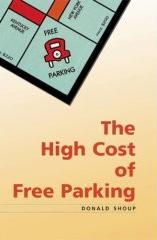
One topic of urban policy has come up again and again over the past year or so of my life: parking. A mild-mannered UCLA planning professor Donald Shoup is convincing more and more urbanists the key the reducing traffic and reforming the shape of our cities is to re-consider our parking policies. Although he makes his case in the intimidating, encyclopedic 734-page tome The High Cost of Free Parking, at its core his argument is quite simple.
Shoup thinks curb parking is too inexpensive. Rather than making parking accessible, he thinks low prices waste huge amounts of time and resources as motorists cruise for open spots. Raising the cost of curb parking to what is necessary to keep a few spaces open at peak hours will reduce traffic, increase turnover of this scarce resource, and bring in new tax revenue that can be used to directly improve the streets where it is collected. This thesis is creatively explained in this short film produced by New York’s Open Planning project.
Our zoning codes also require a certain number of off-street parking spaces for new buildings. Shoup critiques these requirements as a pseudo-science, complaining they are based on statistically dubious studies measuring “demand” for free parking in suburban locations. The cost of this parking, up to $35,000 per space, is almost never passed along to the parking users. Furthermore, the zoning requires parking to satisfy peak requirements, meaning it sits empty almost the entire year. In the aggregate, Shoup thinks the requirements are a total planning disaster: he argues they encourage auto use, damage the economy, degrade the environment, debase architecture and urban design, burden enterprise, prevent the reuse of older buildings, among a litany of other offenses. In Shoup’s view, “Off-street parking, far more than the interstate highway system, have spurred the dominance of the automobile.”
He concludes that “if cities deregulate off-street parking and charge the right price for curb parking, market forces will improve transportation, land use, the environment, and urban life.” While I think turning the requirements into maximums is a more pragmatic first step, it’s hard to reject his argument our policies should make parking users pay its full cost. Almost three years after its publication, the book’s sales seem strong: it is #2 American Planning Association’s list of bestsellers and among the top 100,000 titles on Amazon, no small feat for a $50 treatise on a mundane aspect of urban policy.
Reading the book inspired me to review what amount of parking region’s zoning codes require. The results of the survey are below, but I should make an important caveat. The codes can be extremely long and complex, making interpreting them difficult. Furthermore, many of the jurisdictions allow developers to reduce these requirements for certain districts of proximity to Metro stations, and almost everything in the zoning code can be negotiated through variances and exceptions. Nonethless, the findings seem to confirm Shoup’s complaint the requirements are inconsistant and excessive, especially if you consider each space required below could require up to 300 square feet of space in a parking structure and cost up to $35,000 or more.
|
|
|
|
|
|
|
|
How many parking spaces are required for different types of buildings? |
|
|
|
|
|
|
|
Montgomery County |
DC |
Arlington |
Alexandria
|
|
|
Single Family House |
2 |
1 |
1 |
2
|
|
|
Apartment |
1 to 2 per unit |
1 to 4 per unit |
1.125 per unit for the first 200, 1 per unit for the remainder |
1.3 to 2.2 per unit
|
|
|
Hotel |
0.5 to 0.7 spaces per room, plus 10 per 1,000 GSF of meeting space |
1 for each 2 to 8 sleeping rooms, or in C-M, M 1 for each room usable for sleeping plus 1 for each 150 SF, whichever is greater |
1 per room |
1 per room, more than three stories 1 per two rooms
|
|
|
Office |
1.9 to 3.0 per 1,000 GSF with variety of reductions possible |
0 to 1 for each 600 SF beyond 2,000 SF |
1 per 250 to 400 SF |
1 per 450 to 600 SF
|
|
|
Industrial |
1.5 per 1,000 GSF |
1 for 1,000 GSF |
1 per 1,000 SF or 1 per 2 employees, whichever is greater |
|
|
|
Retail |
5 per leasable 1,000 GSF |
none for under 3,000 SF, beyond that 1 per 300 SF |
1 per 250 to 300 SF |
1 per 200 to 330 SF |
|
However, in D.C. there is considerable interest in re-evaluating the parking requirements. The city has recently launched a major effort to undergo a comprehensive revision of the zoning code. As part of the process the Office of Planning has organized committees examining each aspect of the code, who will each hold multiple meetings open to the public. The documents used to kick-off the parking committee this week are online, and include an excellent summary of best practices in parking policy by the innovative firm Nelson/Nygaard.
Two upcoming projects in D.C. are also putting parking issues at center stage. The Washington Nationals Ballpark is set to open March 30th, and in response D.C. Councilmember Tommy Wells has proposed an innovative curbside parking management proposal that would implement the sort of policies advocated by Shoup. In Columbia Heights, the massive DCUSA project set to open March 8 and Councilmember Jim Graham recently called several hearings where new policies for the neighborhood were discussed. The brewing events mean 2008 could be the year for parking policy in Washington.
Posted: September 23rd, 2007 | Author: Rob Goodspeed | Filed under: Hyattsville, Maryland, Smart Growth, Urban Development | 5 Comments »

Less than one mile from the District of Columbia stands acres of vacant land. Wildflowers and grasses have gone to seed on a long-abandoned playing field (above). Weeds sprout in a dry, sun-drenched lot (below). An abandoned warehouse sits on land abutting picturesque parkland. Although large lots of undeveloped land inside the beltway are rare enough, these photos are even more remarkable if one considers the land is surrounding a Metro station.

This curious phenomenon is not due to inadequate zoning or neighborhood resistance. The area has been zoned for transit oriented development since the 1990s, and the Prince George’s County Planning Department recently published a special transit district plan for the area, that would accommodate thousands of housing units, a million square feet of office and retail space, and a system of public parks and open space.


There are a myriad of causes for the lack of development. The suburban jurisdictions most successful at cultivating transit oriented development, Montgomery County and Arlington County, revised their zoning codes early after the advent of Metro and even there it has taken decades to realize transit oriented developments. (Despite decades zoned for high density development, almost all of the buildings near the Ballston Metro Station were built in the last ten years.) Prince George’s County has taken a more piecemeal approach, creating small transit districts instead of revising the entire county’s plans. A recent Washington Post story suggests political leaders and Metro itself may share part of the blame. Furthermore, this area has significantly lower incomes than Arlington or Montgomery, and the county as a whole hasn’t seen the same amount of investment as elsewhere in the region.
Regardless of the precise causes, our region has already spent billions constructing a transit system and suffers some of the worst traffic and sprawl of any city in America. We have a mandate to realize development at sites as well-situated as the West Hyattsville Station.