Will Electric Cars Fuel Urban Sprawl?

Posted: January 13th, 2009 | Author: | Filed under: Energy, Parking, Sustainability, Transportation | Tags: , , | 6 Comments »

Shai Agassi has an idea so revolutionary it’s convinced venture capitalists to commit hundreds of millions of dollars, major corporations to sign on, and the leaders of countries around the world scrambling to sign up to be the guinea pigs for his new technology. It’s also an idea that, as soon as it is heard by many Americans, causes them to sneer. Perhaps this response should be no surprise, since Agassi’s idea aims to completely revolutionize the quintessential American mode of transport, the automobile.

Automobiles are ripe for re-invention, but progress is halting. Between pure electric, fuel cells, ethanol, plug-in hybrids, and natural gas vehicles, the technology of the sustainable auto of the future is anything but clear. Other, less practical concepts abound. Some urbanists are keen to make the city totally car-free, based around bicycles, walking, and transit.

The Concept

Better Place ChargeAgassi, formerly an executive with the global software company SAP, struck upon what he thinks will become a paradigm shift for the auto. In his plan, owners of electric vehicles subscribe with his company. In exchange for the fees they pay (carefully calibrated to be below the cost of operating a gasoline vehicle) they get the right to swap their batteries at a large network of re-fueling stations, or charge up at special plug-in spots located at work or even their home. The car’s computer shows the way when the charge is low. The company charges the batteries using wind farms, solar generation, and other sustainable sources. The difference between the subscriber fees and the amortized cost of the infrastructure and battery service is pure profit. Countries eager to shift their transportation systems away from petroleum can further encourage a shift to electric technology through tax differentials on the autos themselves. Israel has planned a differential based on environmental impact: electric cars will be taxed at a 10 percent rate, compared with 79 percent on gas-powered cars and 30 percent on hybrids.

What about the notorious range problem for all-electric vehicles? Better Place claims their vehicle, developed by the Renault-Nissan Alliance, will have a range of 100 miles. Roughly 95% of all daily auto trips in the U.S. are less than 30 miles, and over 99% are less than 100 miles. Given a liberal smattering of battery changing stations, the range problem is vastly reduced.

The logic is compelling. After all, we already use one privately owned network infrastructure on a daily basis, for cellular phones. The subscriber model means most can get phones for very low cost, and a vibrant market exists for new and used handsets. The dashing CEO has been convincing quite a few political leaders, with deals inked to build networks in Denmark, Israel, and Australia, and plans underway for Hawaii and the San Francisco region. The governor of economically beleaguered state of Michigan even took a test drive in the company’s prototype in November. (above)

Urban Effects

In general I’m not as skeptical as some critics. The concept seems sound, particularly for geographically compact regions like Israel and Hawaii. But what will the impact of the Better Place system be on our cities? Some would obviously be positive. Since private vehicles are major sources of air pollution, mass adoption of electric vehicles will result in immediately improved public health and cleaner air. Taxicabs and Zipcars (already leased from designated parking spots) could be converted to clean, all-electric fleets.

When it comes to urban form, the result is less clear. In the words of two Israeli environmentalists:

Car-based transportation requires the building of more highways and roads, new bridges and intersections that would take up land; it also creates the conditions for urban sprawl, which would take up even more land. This is a non-sustainable solution for Israel.

But would it? Conventional urban economic theory holds that that transportation systems increase the spatial extent (and decrease density) of the city if they reduce the cost of transportation. If we assume the network covers the entire metropolitan area, and the Better Place system was less expensive than gasoline cars, it could encourage sprawl and cause new, electric-car fueled traffic congestion on our roads. The networked system might result in a altogether new urban form, both less centralized than the rail-dominated cities of the early 20th century, or the formless sprawl facilitated by the long range of gasoline vehicles. Slightly shorter ranges than gasoline combined with the modern economy could encourage the development of polycentric urban areas, perhaps unintentionally anticipated in this Wired illustration of the Better Place network, where freeways loop strangely around nodes of skyscrapers and no sidewalks are in sight.

Driven: Shai Agassi's Audacious Plan to Put Electric Cars on the Road

In fact, Agassi’s plan could have another unintended effect: boosting the number of cars in the city. In a worst-case scenario, where the network (or tax policies) subsidize the cost of the vehicle and make driving even cheaper than gasoline transport, Better Place could boost rates of auto ownership and distance traveled, exacerbating parking shortages and traffic.

How can we avoid these outcomes? Property pricing parking and abolishing parking requirements in urban areas would help auto owners bear the true cost of their intensive use of urban space and ensure all vehicles can park. Congestion pricing policies could reduce congestion in dense urban areas, shifting travel to more space-efficient transit. Our cities will need continued transit investment.

With the first charging station open in Israel and Renault-Nissan’s vehicles set to hit Israeli streets in 2011, these questions may be answered in just a few years.

> Wired: “Driven: Shai Agassi’s Audacious Plan to Put Electric Cars on the Road
> Economist: “Renault-Nissan’s ambitious plans for all-electric cars
> Better Place

Better Place photos: Renault-Nissan electric car in Denmark, Better Place Israel CEO at the first charging station, Better Place CEO Shai Agassi and Michigan Governor Jennifer Granholm; Wired Magazine illustration


The Paradox of Cheap Parking, in Real Time

Posted: December 18th, 2008 | Author: | Filed under: Ann Arbor, Michigan, Parking, Urbanism and Planning | 15 Comments »

Last spring, I heard about an interesting dataset about Ann Arbor, Michigan, where I lived for four years as an undergraduate student. Busy with the flurry of activity leading up to my completion of graduate school, I stored it away to look at later. After all, real-time information on cities is hard enough to come by, let alone on the simultaneously ubiquitous and fascinating topic of parking.

The Data
The parking lots and structures in downtown Ann Arbor are operated by a quasi-public organization, the Ann Arbor Downtown Development Authority (DDA). Together with their parking vendor, last April they implemented a system that provides real-time information about the number of parking spaces available in several lots and garages through digital signs at each garage and through their website. An old Ann Arbor friend Brian Kerr wrote a simple script to scrape that page every 20 minutes and record the number of spaces available at each facility. After letting it run for about two weeks, he posted the data file online. Subsequently a local blogger interviewed the DDA’s IT manager about how the system was implemented, and even posted some charts encouraging visitors to match the chart with the garage. The data sparked a bit of interest on local blogs but the conversation soon died out.

At the time of the completion of a recent parking study in 2007, the DDA operated lots and structures containing 5,770 parking spaces in downtown Ann Arbor. These facilities are concentrated in a relatively small physical area, as shown in this map from the study:
Parking4 (72 pages)

For my first pass at the data I thought I’d look at just one garage, indicated by the arrow above. As is shown, the Maynard Street structure is near two movie theaters, a busy commercial district, and one block from the University of Michigan Central Campus Diag, with many classroom buildings and a large auditorium. The first chart is the number of spaces available in just one day – Monday, April 7, 2008:

DDA Parking

The first thing to notice is that the garage is never full during any 20-minute measurement. Although the technical capacity of the garage is 797, the garage flat-lines at 618 (perhaps due to long-term permits or construction). The garage is only filled over 90% of this reduced capacity for one 40-minute period, from 1:40 p.m. to 2:20 p.m, or roughly 2.7% of the entire 24-hour period.

Expanding the time frame for the next 7 consecutive days reveals this pattern:

Maynard Garage

The spikes correspond with the midday rush, and the garage only fills once, around 1:00 p.m. on Friday, April 11th. This seemingly dry data can tell a rich sociological story; everyone rushes in just after nine, with various people lingering around into long into the evening. In a sense, the curve represents a unique DNA of the local land uses and the preferences and customs of their auto-using patrons, residents, and visitors.

Observations
Based on the data we can make a couple observations. First, the vast majority of the parking lots and structures are almost totally empty the majority of the time. This means they represent a huge amount of inactive urban space. A common rule of thumb is each structured space takes up 300 square feet of floor space for the bay and associated aisles and ramps. If we use this standard, the same floor area in this garage could be 239 apartments (assuming they average a generous 1,000 square feet). Certainly good design would demand a residential structure be taller or configured differently on the site. However, given the extremely fickle use of the garage now, a residential use would mean more people physically at the site on average than are now.

Second, from the chart above we can see that parking demand at the DDA’s prevailing price structure is very spiky, with extremely high demand only at limited times. (This garage costs $.80 an hour, or $175 for a monthly permit) It would seem logical for the DDA to use variable or tiered pricing to create a market incentive for a more efficient use of their space. For example, parking overnight could be inexpensive given the very low demand, with parking around the midday peak much more expensive. Even a modest form of performance parking may change this observed pattern.

Overparked?
Maynard Street Parking Structure2

Despite nearly 5,800 spaces the DDA continues to develop more parking, this October publishing on their website details about a proposed underground lot near the library boasting green design. How will the city know when they have enough parking? After all, parking policy guru Donald Shoup points out one can rarely provide enough of something that’s under priced. The proposal for the new garage advises readers to “review the findings of the 2007 Parking Study to learn why vehicle parking is needed even with extensive investment in alternative transportation.” Unfortunately the 2007 Parking Study doesn’t exactly settle the matter, including as one of its final recommendations “Maintain a formalized process for determining when new supply is needed.” The study, by the alternative transportation experts Nelson/Nygaard, is chock full of state-of-the-art policy suggestions (including variable pricing discussed above) but avoids the sticky question of determining how much is necessary. Perhaps it’s because like other seemingly scientific questions in urban planning the answer is not scientific but value-laden and political. (A similar question: How many freeways and/or lanes do we need?) And in Ann Arbor, the people want more parking.

Parking in the Real-Time City
In another vein, publishing this real-time data (especially on a still forthcoming mobile format) could itself have profound implications for the transportation system. Could real-time data allow people to avoid full structures and make use of the resource more efficient? The Washington, D.C. suburban rail station lots tend to fill up early, and I’ve heard stories of people driving downtown stopping at each station to look for a spot. What if the space was beamed to their home computer or car? (The more important question might be, “How much parking should they provide to begin with, and what should it be priced?” One suggestive study I saw of San Francisco’s BART concluded replacing parking with offices would boost the agency’s riders and revenue) If the DDA makes summary data available on the website, it would make costly data collection unnecessary for this data point. All citizens would know exactly how full or empty the garages were, and the DDA would be able to observe the impact of pricing or policy changes in real time.

> Previous parking posts: The Urbanists’ Panacea: Parking Reform, Are Expensive Parking Meters Fair?, more
> Homeless Dave’s Interview with the DDA’s Stephen Smith
> Ann Arbor Downtown Development Authority


We Need Congestion Pricing

Posted: June 16th, 2008 | Author: | Filed under: Congestion Pricing, District of Columbia, Parking, Transportation | 5 Comments »

Maybe it was during a 20-minute, 2-mile taxi ride from Georgetown to downtown D.C., where my average speed was 6 miles per hour. Or maybe it was during a lurching bus ride across K Street that took perhaps half an hour to traverse the same distance. During both trips, city street were jammed with large, single-occupancy vehicles, while buses, delivery trucks, and business vehicles were slowed to a crawl.

Washington, D.C. needs to get serious about downtown congestion. London congestion pricing has been a smashing success, with the Times reporting today on an unexpected benefit: drastically reduced parking costs downtown. Not the mention the significant revenue for public transportation investment. Now officials in Manchester are contemplating a two-ring system that would charge motorists £1-3 to enter the city, depending on the time of day and location. While business types are skeptical (as they usually are) the only evidence they can marshal are opinion polls. That takes us to Paris, a city that has cut auto use by 20 percent in seven years — without London-style congestion pricing. When parking spaces were converted to a dedicated bus route, the residents of the Left Bank neighborhood of Montparnasse held a funeral, predicting the death of the neighborhood. Now the owner of a famous cafe admits “We’ve come to love it,” noting the bus brings workers and customers with improved efficiency. Elsewhere in the city, programs initiated by mayor Bertrand Delanoë are raising the cost of parking, creating dedicated bus and bicycle lanes, making tens of thousands of bikes available for rent, and “civilizing” the city’s most car-friendly streets by cutting lanes and expanding pedestrian space.

D.C.’s attempts are meager in comparison. Increased parking meter prices are only in effect in several neighborhoods. The tiny and highly-hyped bike sharing program still hasn’t launched despite media reports it would start in May. The networking of bicycle lanes and trails is fragmented and far shorter than other U.S. cities. DDOT’s experimental bus and bicycle lane on 9th Street downtown is too short and poorly marked and enforced to make much of a difference.

The solutions to congestion are at hand, all that’s lacking is the resources and political will to do them.


Montgomery County Loves to Park

Posted: April 10th, 2008 | Author: | Filed under: Maryland, Parking, Urbanism and Planning | Comments Off

In a previous post on parking I reviewed some of the region’s bloated parking requirements. Today I was re-visiting the Montgomery County Zoning Code’s parking requirements and decided to post a more detailed list. Although these requirements can be adjusted somewhat for uses near Metro stations or in parking districts or for other reasons, this list is taken verbatim from the zoning code as the standard requirements. The next time you’re struck by excessive suburban parking, remember it is often our laws that put it there. The D.C. regulations can be found here, and they generally require a bit less.

Read the rest of this entry »


Are Expensive Parking Meters Fair?

Posted: March 4th, 2008 | Author: | Filed under: District of Columbia, Parking, Smart Growth, Transportation | 10 Comments »

ThinkUrban neighborhoods across America have a “parking problem.” Free curb spaces are hard to come by during busy times, especially in commercial areas. Because curb spaces are so much cheaper than garages, drivers continue to cruise for spaces. That’s the reason one of the major recommendations of parking reformers like Donald Shoup is raise the price of on-street parking, particularly in commercial districts. (I’ll discuss his proposals for residential neighborhoods later.) In their view, the “shortage” of on-street spaces results because the spaces are underpriced. As a result, drivers cause huge amounts of wasted time, fuel, and unnecessary traffic. These spaces should instead be priced high enough to ensure a few empty spaces at all times. During peak periods parking would be expensive, but at other times it would be much cheaper or even free.

In response to my recent post on Donald Shoup’s High Cost of Free Parking, one commenter asked “isn’t the curb thing just regressive taxation, discriminating who can shop downtown by income?”
While the economics of the proposal is straightforward enough, the ethics aren’t. Would performance-based meter pricing hurt the poor?

Read the rest of this entry »


The Urbanists’ Panacea: Parking Reform
Posted: February 24th, 2008 | Author: | Filed under: District of Columbia, Parking, Smart Growth | 19 Comments »

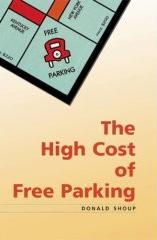
Donald ShoupOne topic of urban policy has come up again and again over the past year or so of my life: parking. A mild-mannered UCLA planning professor Donald Shoup is convincing more and more urbanists the key the reducing traffic and reforming the shape of our cities is to re-consider our parking policies. Although he makes his case in the intimidating, encyclopedic 734-page tome The High Cost of Free Parking, at its core his argument is quite simple.

Shoup thinks curb parking is too inexpensive. Rather than making parking accessible, he thinks low prices waste huge amounts of time and resources as motorists cruise for open spots. Raising the cost of curb parking to what is necessary to keep a few spaces open at peak hours will reduce traffic, increase turnover of this scarce resource, and bring in new tax revenue that can be used to directly improve the streets where it is collected. This thesis is creatively explained in this short film produced by New York’s Open Planning project.

College Park Shopping CenterOur zoning codes also require a certain number of off-street parking spaces for new buildings. Shoup critiques these requirements as a pseudo-science, complaining they are based on statistically dubious studies measuring “demand” for free parking in suburban locations. The cost of this parking, up to $35,000 per space, is almost never passed along to the parking users. Furthermore, the zoning requires parking to satisfy peak requirements, meaning it sits empty almost the entire year. In the aggregate, Shoup thinks the requirements are a total planning disaster: he argues they encourage auto use, damage the economy, degrade the environment, debase architecture and urban design, burden enterprise, prevent the reuse of older buildings, among a litany of other offenses. In Shoup’s view, “Off-street parking, far more than the interstate highway system, have spurred the dominance of the automobile.”

He concludes that “if cities deregulate off-street parking and charge the right price for curb parking, market forces will improve transportation, land use, the environment, and urban life.” While I think turning the requirements into maximums is a more pragmatic first step, it’s hard to reject his argument our policies should make parking users pay its full cost. Almost three years after its publication, the book’s sales seem strong: it is #2 American Planning Association’s list of bestsellers and among the top 100,000 titles on Amazon, no small feat for a $50 treatise on a mundane aspect of urban policy.

Reading the book inspired me to review what amount of parking region’s zoning codes require. The results of the survey are below, but I should make an important caveat. The codes can be extremely long and complex, making interpreting them difficult. Furthermore, many of the jurisdictions allow developers to reduce these requirements for certain districts of proximity to Metro stations, and almost everything in the zoning code can be negotiated through variances and exceptions. Nonethless, the findings seem to confirm Shoup’s complaint the requirements are inconsistant and excessive, especially if you consider each space required below could require up to 300 square feet of space in a parking structure and cost up to $35,000 or more.

How many parking spaces are required for different types of buildings?

Montgomery County DC Arlington Alexandria

Single Family House 2 1 1 2

Apartment 1 to 2 per unit 1 to 4 per unit 1.125 per unit for the first 200, 1 per unit for the remainder 1.3 to 2.2 per unit

Hotel 0.5 to 0.7 spaces per room, plus 10 per 1,000 GSF of meeting space 1 for each 2 to 8 sleeping rooms, or in C-M, M 1 for each room usable for sleeping plus 1 for each 150 SF, whichever is greater 1 per room 1 per room, more than three stories 1 per two rooms

Office 1.9 to 3.0 per 1,000 GSF with variety of reductions possible 0 to 1 for each 600 SF beyond 2,000 SF 1 per 250 to 400 SF 1 per 450 to 600 SF

Industrial 1.5 per 1,000 GSF 1 for 1,000 GSF 1 per 1,000 SF or 1 per 2 employees, whichever is greater

Retail 5 per leasable 1,000 GSF none for under 3,000 SF, beyond that 1 per 300 SF 1 per 250 to 300 SF 1 per 200 to 330 SF

However, in D.C. there is considerable interest in re-evaluating the parking requirements. The city has recently launched a major effort to undergo a comprehensive revision of the zoning code. As part of the process the Office of Planning has organized committees examining each aspect of the code, who will each hold multiple meetings open to the public. The documents used to kick-off the parking committee this week are online, and include an excellent summary of best practices in parking policy by the innovative firm Nelson/Nygaard.

Two upcoming projects in D.C. are also putting parking issues at center stage. The Washington Nationals Ballpark is set to open March 30th, and in response D.C. Councilmember Tommy Wells has proposed an innovative curbside parking management proposal that would implement the sort of policies advocated by Shoup. In Columbia Heights, the massive DCUSA project set to open March 8 and Councilmember Jim Graham recently called several hearings where new policies for the neighborhood were discussed. The brewing events mean 2008 could be the year for parking policy in Washington.

Blog Widget by LinkWithin